ARROW MAKINGArrow making goes back to pre-historic man and one half of the
"tools" needed to harvest game or just shoot targets for fun.
Most of us that grew up where we could wander out the back yard into the
woods and play Cowboys and Indians with family members and kids in the
neighborhood at some point in time has made that ole self bow called a
stick
n string if nothing more than a small sapling bent into an arch with a good
string tied on each end and you had the makings of a bow. The arrows
were small straight reeds or what ever material was readily at hand with a
notch cut into the rear of the shaft to accept the string. The arrow
head could be anything such as a heavy gauge wire or nail with the head cut
off and the end flattened to a point. Getting a little more refined
down the road, we would cut the back and belly from a good piece of
ash or hickory with either pocket knives or a draw knife and
air dry or help the process along by sneaking each end of the bow into the
cook oven but the finished product would still not be equal to a "store
bought" bow but the seed was already planted for "messing"
with archery gear!
Now getting back to my story, arrow making doesn't take a lot of tools
and supplies and not really that expensive once you obtain a small arrow
cut-off saw, fletching jig, glue and an assortment of either feathers or
plastic vanes. If you dip or crest your arrows, dipping tanks will be
needed. Most raw arrow shafts come with a nock and insert and you only
have to cut the shaft to length and apply the fletching. I enjoy
making the arrows and it does save a few bucks especially the re-fletching
of shafts since about every practice session a fletch or two will be damaged
needing the arrow to be fletched again. Inserted a few pixs:
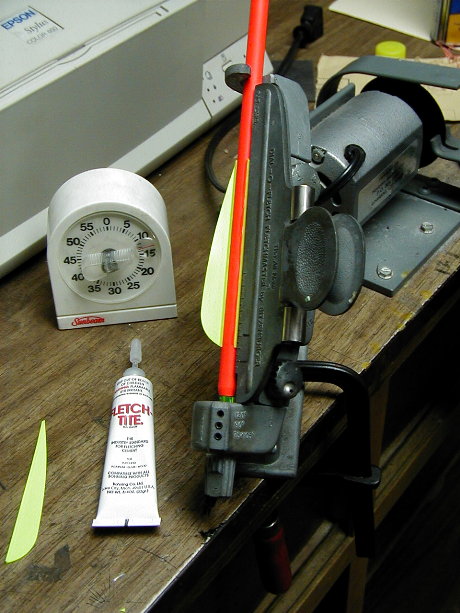
I am using a Bitzenburger Fletchmaster fletching jig circa. early 1980s,
patented in 1959
and you can see the
small cut-off saw to the right. I have a couple Bitzenburger jigs set
for different applications such as hunting and target arrows that have
different degrees of taper/offset to the fletch.
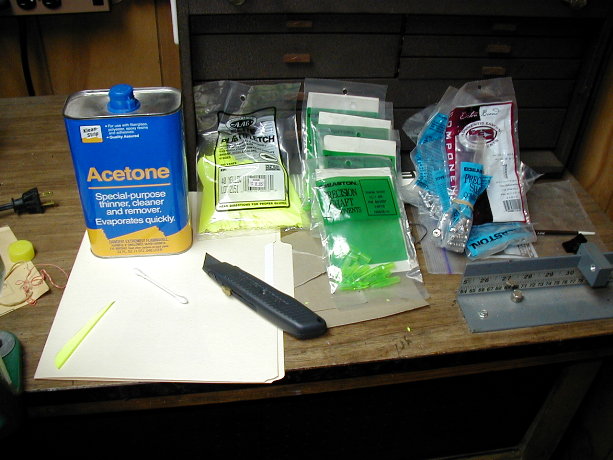
A few of the supplies needed: I clean the arrow shafts with Acetone
however you can get a more aggressive product like MEK (METHYL ETHYL
KETONE) which is highly flammable and getting harder to obtain because of
it's nature. The majority of my hunting shafts are dipped with a base
coat of white and rocket red applied and a clear sealer over that, however I
sometimes leave the clear coat off....all three products made by Bohning
Company. I obtain my archery supplies from long time friend Jim
Skipper at Skip's Archery Shop, 7608 Circle Dr., .Indian Trail,
NC 28079 Telephone: 704-882-1844. Jim has a full-time
Archery Pro Shop and knows his business!
Jim Skipper moved his archery shop a few years ago to Mineral Springs, NC
which housed a small indoor archery range.
NOTE: Jim aka "Skip" Skipper passed to the next life on
11-02-17. He was first class in all that he did!
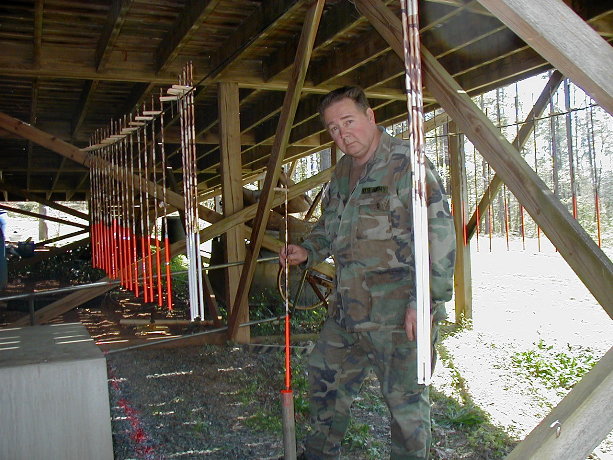
No, Bill Porter is not hanging his laundry out to dry, but dipping several
dozen Easton XX78 raw shafts that are receiving the Rocket Red color on top
of some previously dipped white shafts. At this stage of arrow making,
I believe the arrow maker might have lost a few of his marbles. If you
have ever dipped arrows inside without proper ventilation. you would easily
understand why I am outside with this part of the arrow making process.
Besides, I don't have to worry about the shop floor getting repainted
either. Take note of the clothes pins and you can't see the nail that
goes down inside the clothes pin spring hole to keep the arrows onto the
line.
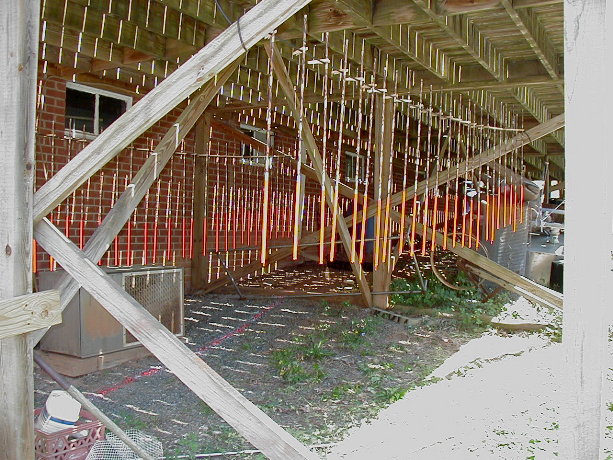
Another view of the drying operation. The light between the deck
flooring is giving some optical illusions for sure and nearly matches the
angle of the arrow orientation!
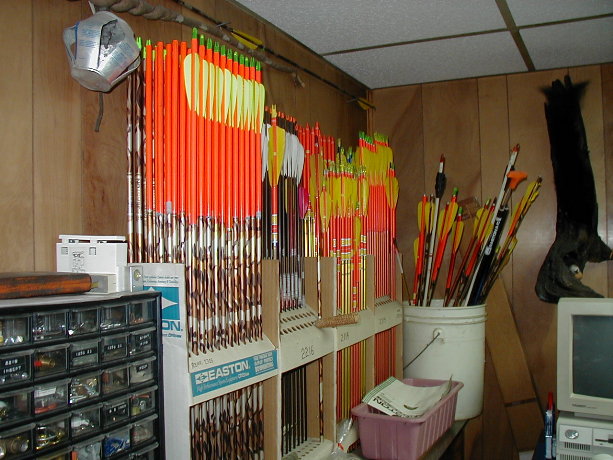
The dipped arrows with some fletching without any type of cresting
applied......I not longer apply or have applied any cresting to my arrow
shafts since I do not shoot tournament archery anymore and the cresting is
for "show" anyway. The bright dipped arrow does have its
advantage such as following the arrow flight, whereby you can see the point
of impact on your animal or target, however it can be a disadvantage at
times too, if you move around with that bright arrow and fletch spooking
game.
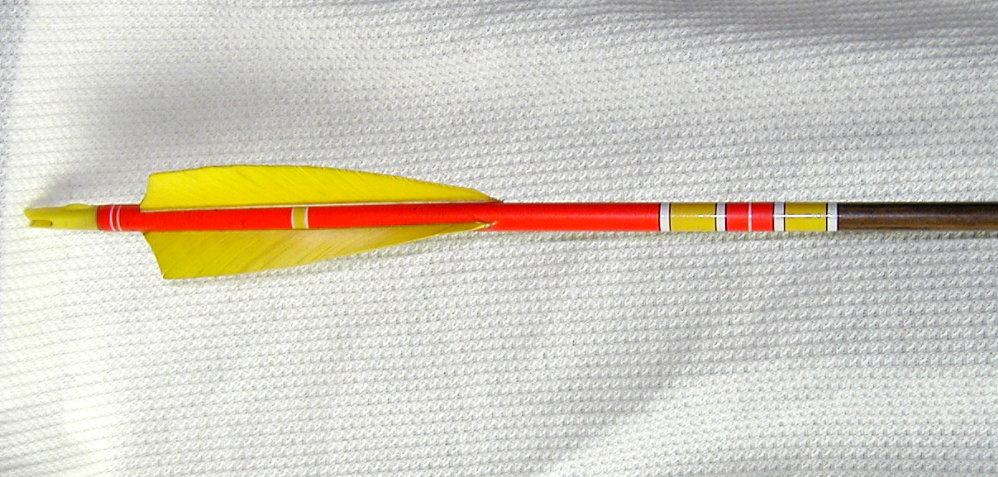
Above arrow was dipped and crested by Bobby "cheese" Winfree of
Wadesboro, NC. Bobby shoots recurve archery equipment only and one of
the fastest shots with a recurve bow I have ever seen. I had
Bobby to crest my tournament arrows when I shot traditional equipment and he
is one of the best at cresting arrows around these parts. I don't
think Bobby does any serious arrow making at the present time. His job
with the US Postal Service keeps him on the go. The above shield
pattern on the feather is still in use by traditional archers but has given
way to the parabolic design because the parabolic shape is much quieter, but
the ole shield pattern still has the looks of a traditional arrow.
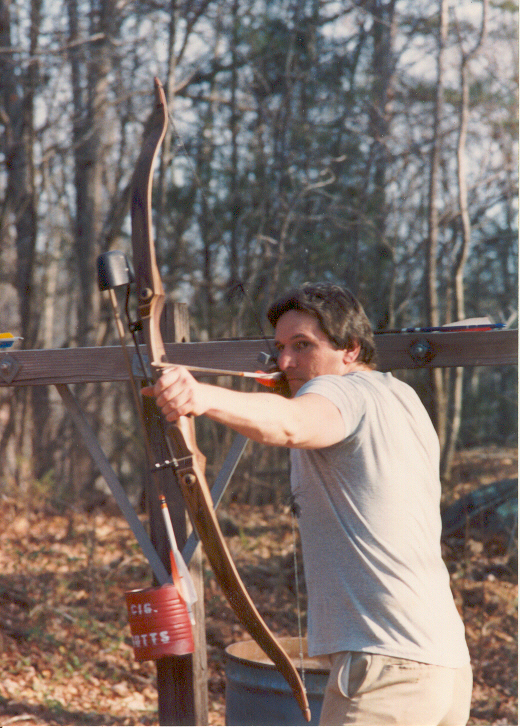
Pix of Bobby Winfree mid 1980's:
Web published by Bill Porter aka Mickey Porter on 08-31-08 and updated on
11-13-17.LEAVING ON A
SPIRITUAL NOTE
If you do not know Jesus Christ as your Lord and Savior, please take
this moment to accept him by Faith into your Life, whereby Salvation
will be attained.
Ephesians 2:8 - 2:9 8 For by grace are ye saved through
faith; and that not of yourselves: [it is] the gift of God: 9 Not of
works, lest any man should boast.
Hebrews 11:1 “Now faith is the substance of things hoped for,
the evidence of things not seen.”
Romans 10:17 “So then faith cometh by hearing, and hearing by
the word of God.”
Open this
link about faith in the King James
Bible.
Romans 10:9 “That if thou shalt confess with thy mouth the
Lord Jesus, and shalt believe in thine heart that God hath raised him
from the dead, thou shalt be saved.”
Open this
link of Bible Verses About Salvation,
King James Version Bible (KJV).
Hebrews 4:12 “For the word of God is quick, and powerful, and
sharper than any two edged sword, piercing even to the dividing asunder
of soul and spirit, and of the joints and marrow, and is a discerner of
the thoughts and intents of the heart.”
Romans 6:23 “For the wages of sin is death; but the gift of
God is eternal life through Jesus Christ our Lord.”
Romans 3:23 “For all have sinned, and come short of the glory
of God;”
Micah 6:8 “He hath shewed thee, O man, what is good; and what
doth the LORD require of thee, but to do justly, and to love mercy, and
to walk humbly with thy God?”
Philippians 4:13 "I can do all things through Christ which
strengtheneth me."